EDITOR'S COMMENTS
Brought to you by:

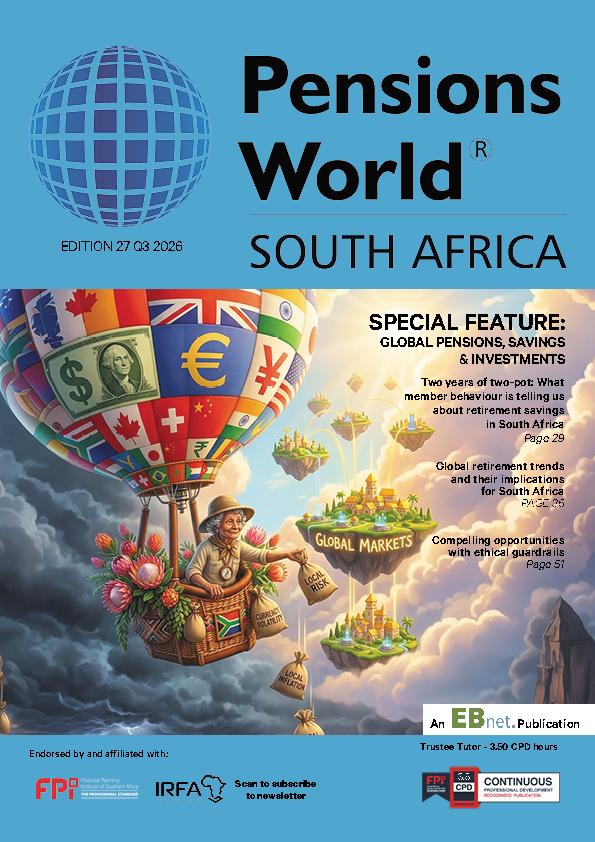
Q3 | 2026
The special feature for this quarter’s issue is global pensions, savings and investment. It lands at a time when long-term capital is being tested on multiple fronts. Geopolitical tensions, stubborn inflation in some markets and shifts in monetary policy have all reminded us that retirement savings sit squarely in the real world, not in some abstract vault of an administration system. At the same time, global pension reform continues to accelerate: auto-enrolment is being strengthened, how members convert their savings into retirement income is under the spotlight, and regulators are pressing harder on value for money, governance and transparency. Against this backdrop, this quarter’s issue is deliberately outward looking, while firmly anchored in the South African context.
Right now, the conversation in employee benefits is zoning in on member experience and personalisation. Our articles explore how greater choice doesn’t automatically translate into better outcomes, a theme that runs through debates on defaults, advice and guided decision making. Discussions at the 2026 actuarial pensions seminar for the Retirement Matters Committee of the Actuarial Society, remind us that sound technical foundations still matter when markets are volatile and longevity risk is rising. The two-pot system and the early behavioural data it is generating becomes a critical reference point as South Africa confronts adequacy.
On the investments side, this quarter’s articles are strongly tilted to “real world” assets and responsibility. From residential rental in long-term portfolios to unlocking tribal areas as the next investment frontier, the case for aligning pension capital with inclusive growth is made in practical terms. The debate around capital, choice and compulsion sits neatly next to commentary on the SARB’s evolving inflation targeting journey and tilted equity benchmarks, reminding asset stewards that macro policy choices and index construction are not neutral for member outcomes.
Our Trustee Tutor on global pensions, savings and investments connects South African readers to international trends, legislative frameworks and how different countries around the world provide and encourage their citizens to save for retirement.
Finally, I would encourage you to spend time with our spotlight supplement on the latest Responsible Investment in South Africa report. It offers a concise lens on how ESG integration, stewardship and impact are evolving in our market, and what that means for boards and asset owners who are increasingly judged not only on returns, but on the way those returns are generated.
As always, Pensions World SA aims to give trustees, principal officers, consultants and asset managers both perspective and practical tools. I hope this issue helps you situate your fund in a global conversation, while sharpening the decisions that must ultimately be made here at home.
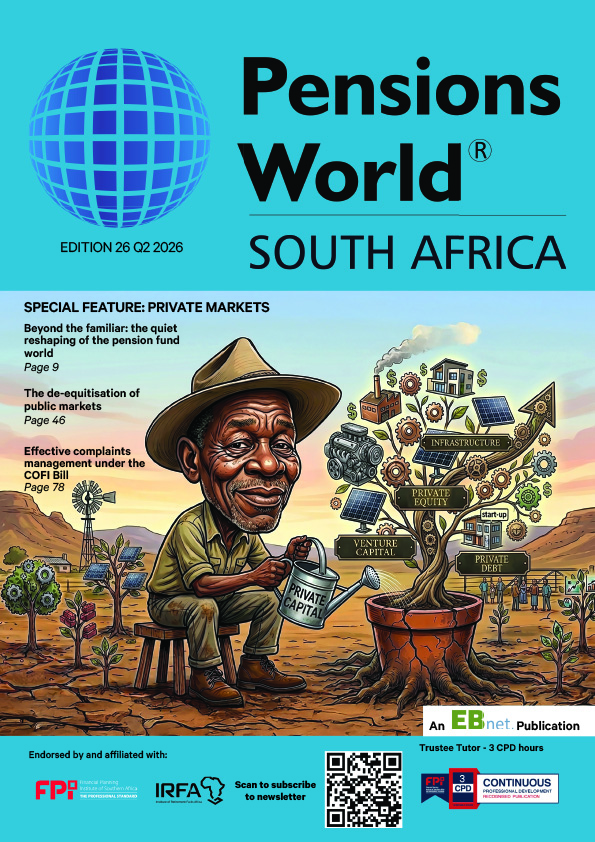
Q2 | 2026
This quarter’s edition arrives at a time when South Africa’s retirement industry is being subtly but decisively reshaped, accelerated by the changing global geopolitics and macroeconomics. The familiar anchors of listed markets and conventional benefit structures remain, but the real momentum lies in how funds are rethinking benefits, governance and their role in the real economy.
At the centre of this issue is a recognition that the status quo is no longer sufficient. The “quiet reshaping” of the pension fund world invites us to look beyond marginal tweaks and interrogate whether our funds are genuinely fit for a more complex, more volatile environment. Alongside it, the examination of consolidation, governance and behaviour in the retirement industry reminds us that structure, oversight and conduct matter as much as returns when members judge whether the system is working for them.
Running through this quarter’s edition is a special focus on private markets, reflecting how strategically important this opportunity has become for retirement funds. Long-term institutional capital and private markets are now deeply interdependent: retirement funds are able to provide the patient capital that allows private assets to function. And private strategies, in turn, open investment opportunities into environmentally and socially meaningful companies not listed in public markets. The Special Supplement shares real world examples of how infrastructure, private credit and real-economy equity can deliver meaningful returns while financing the energy transition, infrastructure and job-creating businesses.
The call to action is clear. Asset owners need to ask more of their advisors and partners – on transparency, reporting quality, valuation discipline, fair fees and alignment of interests – while also recognising that this is an asset class that only works if capital is committed at scale and with patience. On the other side, managers must treat retirement funds not as counterparties to be optimised against, but as long-term partners whose fiduciary obligations shape how mandates are designed and executed.
As you move through this issue, I invite you to view every article – from governance and Regulation 28 implementation to impact-focused township investing – through that partnership lens. The question for each decision maker is no longer whether to engage with private markets, but how to do so in a way that turns member savings into tangible, long-term value in the real economy, while staying true to the promises made to every retiree.
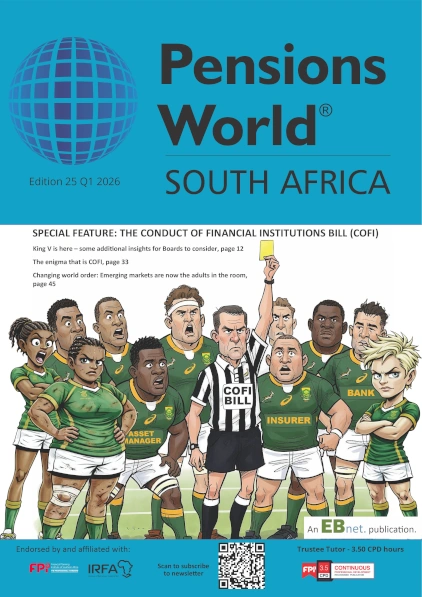
Q1 | 2026
As we start 2026, South Africa’s benefits landscape reflects resilience amid economic and geopolitical headwinds, with regulatory shifts poised to reshape how retirement funds deliver value to employees.
Members of retirement funds enjoyed kind investment markets in 2025, buoyed by a robust JSE All Share Index rally that ranked among the world’s top performers in both rand and dollar terms. Looking ahead, economists anticipate moderate growth for South Africa’s economy in 2026, building on 2025’s tentative recovery. GDP expansion is forecasted at between 1.4% and 1.5%, up slightly from 1.2% last year, headline inflation is expected to edge up to 3.6% and general consensus is that the SARB will deliver another 50 basis points in rate cuts, (following 100 bps relief in 2025). This quarter’s investment articles expand on all of these and guide investment thinking around our meeting tables.
One could not avoid discussing the topic of the regulatory environment’s increased demands on conduct and governance in 2026. COFI edges toward enactment this year, ushering in outcomes-based licensing and fair customer treatment standards that will test funds and service providers’ conduct in the value chain of providing members with benefits they can trust. King V, effective January 1, streamlines to 13 principles with a nine-year board independence cap and tech governance mandates, applying directly to retirement funds for enhanced transparency. Although following King V is not mandatory, in this current regulatory environment we see many funds embedding these governance principles.
The investment and regulatory dynamics of 2026 directly influence the design of employee benefits, amplifying the need for prudent, diversified portfolios under Regulation 28 to shield retirement savings from volatility. Strong 2025 performance bolstered retirement fund values, but COFI and King V push trustees toward holistic oversight, ensuring benefits align with long term member outcomes, amid recent tweaks like the two-pot system.
Forward-thinking funds are pivoting to integrated employee benefits – blending retirement with wellness, financial literacy and mental health support via data-driven personalisation. This holistic model, leveraging tech for tailored packages, positions retirement funds as comprehensive security nets, fostering retention in a competitive talent market.
We hope that this issue, with its special feature on COFI and what you can expect, positions you to navigate these changes proactively to maximise impact.
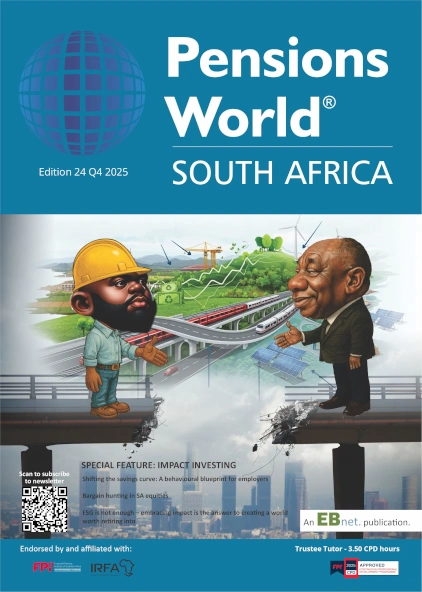
Q4 | 2025
Our fourth quarter issue offers an opportunity to reflect on the very busy year that 2025 has been. It started with Donald Trump’s inauguration as the 47th president of the United States, sending economic and geopolitical ripples around the world. Tariffs, turbulence and trust remain key talking points.
Yet in this environment of uncertainty, markets have hit record highs, including our own bourse which broke the 100 000 points mark in July. In fact, as I write this, the South African equity investor has enjoyed bumper returns in 2025, with the FTSE/JSE up over 30% for the year. (This, of course, subject to change at any time.)
The markets aren’t the only thing that have been on the boil this year. The Regulators have kept service providers and retirement funds busy with the implementation of cybersecurity and cyber resilience policies and practices in June, requiring us all to brush up on our knowledge and understanding of the digital revolution underway. In August, the FSCA published Conduct Standard 2 of 2025, providing a much needed update to the conduct requirements for pension benefit administrators. Introducing things like fit and proper requirements for administrators, as well as complaints and conflicts management frameworks and protocols, this Conduct Standard is the bridge between the old Board Notice 24 of 2002, and the impending Conduct of Financial Institutions (COFI) legislation – now anticipated in 2026. Another step towards greater financial inclusion came in the form of Conduct Standard 1 of 2025, setting the requirements for the provision of financial education, establishing the baseline requirements for consumer financial education initiatives, which will come into effect in March 2026.
Financial inclusion grows when economies grow. And that’s why we’ve chosen to end the year with a special feature on impact investing. For trustees, management committees and individual investors, navigating the complexities of investment strategies, understanding what impact investing truly entails, and how it differs from ESG investing and socially responsible investing (SRI), is crucial. It enables informed decision making that align not only with your fiduciary duties (for decision makers and regulators) but also with the outcome expectations of retirement fund members and investors. After all, it’s not just about the amount of money accumulated at retirement, but also the world that members retire into.
As always, I trust this issue’s valuable insights will prompt your thinking and grow your confidence to navigate the rapidly evolving world around us.
Thank you for sharing another year with the team at Pensions World SA. We wish you a blessed holiday season of rest.
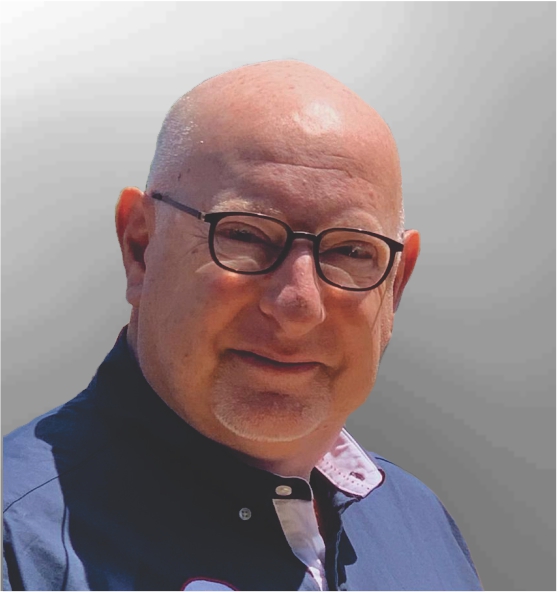
EDITOR
David Weil, CEO ICTS Group of Companies
David is Chairman and CEO of the ICTS Group of Companies. A stalwart of the retirement funds industry, having started his own business in 1995 called Investment Consulting and Training which he sold to the Alexander Forbes Group in 1999 where he occupied a Senior Director position for just over 3 years, before restarting ICTS in 2002. ICTS has the mission statement “to support retirement funds and their members, in collaboration with the fund’s mainstream service providers, by specializing in niche services that complement and enhance the overall retirement funding experience.” David and his team have achieved this in the fields of tracing, death benefit services, training, legal services, EBnet, Pensions World SA, and Motswedi Economic Transformation Specialists. David holds a BA in Economics and Law from Wits, and serves as an independent trustee on a number of retirement fund trustee boards.