

Nokwazi Dube works as an accountant in small-town KZN. Her round-trip commute to work takes around two hours a day. However, if the bridge connecting two key roads on her route was repaired, the daily journey would be just 40 minutes.
Nokwazi, as a trustee of her employer’s pension fund, has often thought that a good use of the substantial assets of the fund would be to invest in infrastructure projects in her community, allowing her contributions and those of her colleagues to work for them in more ways than one.
Nokwazi’s thinking is not new. Many South African fund members and trustees have had similar thoughts of investing in private markets or directly in infrastructure projects.
Private market or unlisted assets often fall under the ‘alternative assets’ banner. They provide an additional arrow in the quiver of long-term investors and are, deservedly, garnering increased attention from retirement funds.
However, the barriers to making this a reality are well documented. Chief among these include income generation, liquidity – regular cashflows as well as the ability to sell the asset quickly, irregular and possibly subjective valuations, high fees, risk of default for private credit investments and exposure to operational failures.
Importantly, this is not a homogenous investment grouping or distinct, separate asset class. Rather, private market assets are alternative versions of assets that might be listed on an exchange i.e. unlisted or private equity, direct property and private debt.
Infrastructure too, is just a particular flavour of private market asset, one that produces structures vital to the development and operation of society.
This interpretation provides insight into the expected behaviour of these investments. Private market assets typically exhibit very different volatility to their listed counterparts, yet their fundamental underlying characteristics are similar. The lower observed volatility is a function of less frequent valuations of the asset, using relatively static assumptions.
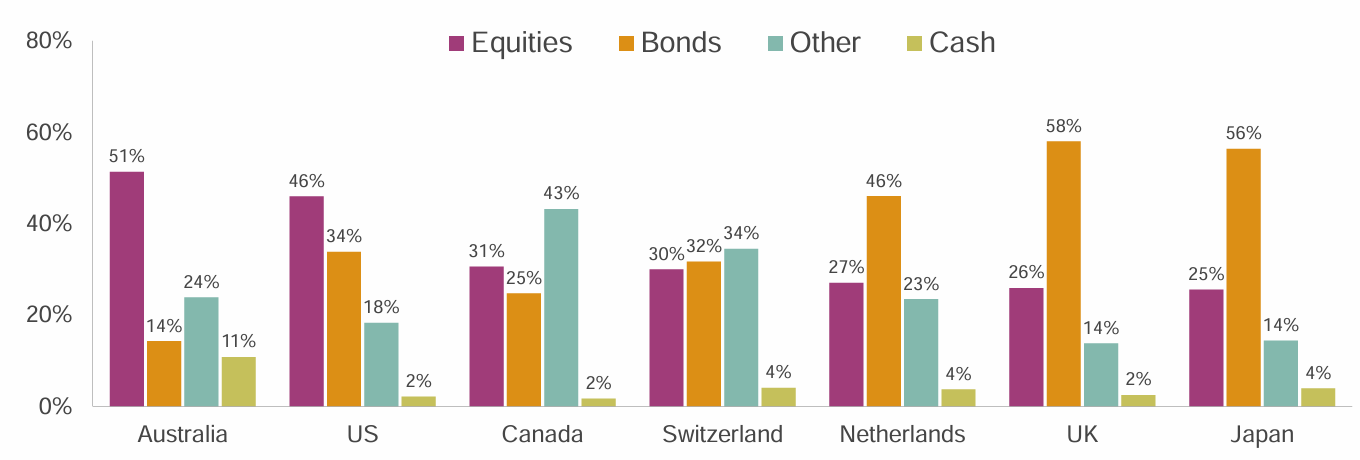
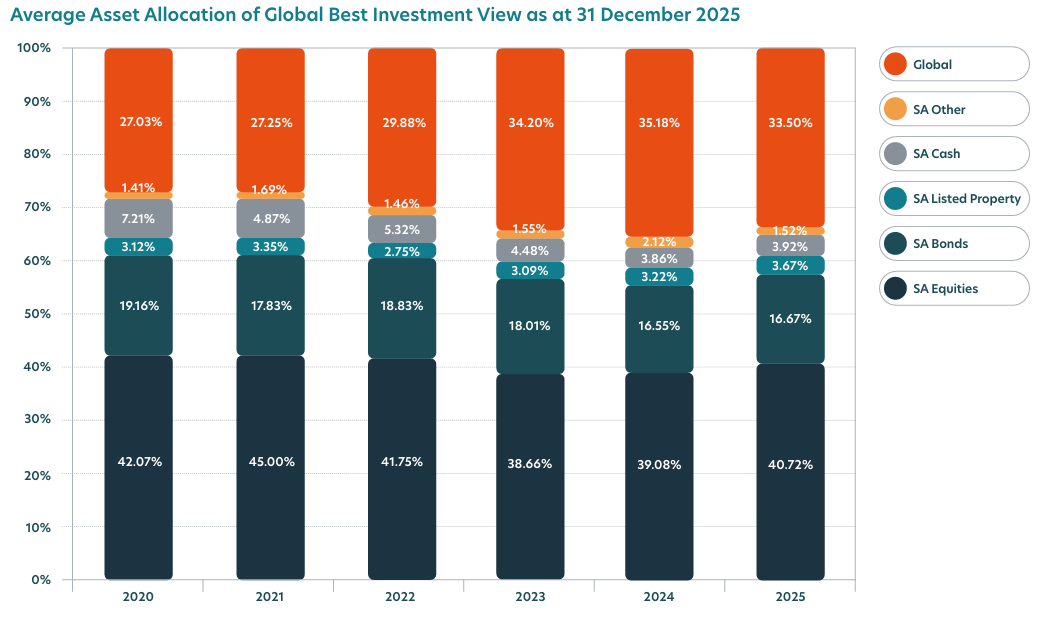
In South Africa, retirement funds allocate significantly less to private markets than their peers in most developed markets. The Thinking Ahead Institute’s Global Pension Assets Study 2024 reveals that, among the world’s 7 largest retirement markets, the allocation to ‘Other’ assets ranges from 14% in the UK and Japan to 43% in Canada (Graph 1). ‘Other’ includes private equity, hedge funds, infrastructure, insurance contracts, commodities etc. By contrast, Alexforbes’ Manager Watch Annual survey for 2025 (Graph 2) indicates that portfolios in the Global Best Investment View category allocate on average only around 1.5% to ‘SA Other’. Clearly there is room for more.
Graph 1
Graph 2
A primary barrier to greater private market allocations is liquidity risk. The two pot system has partially alleviated this by restricting access to the retirement component before retirement, but liquidity provision remains necessary and requires careful ongoing management.
Addressing the liquidity challenge meaningfully requires industrywide collaboration. A practical solution would be the establishment of a marketplace or clearing house – supported by both standalone and umbrella funds as well as retail solutions and platforms – providing a standardised secondary market where private market assets can be traded between retirement funds as their needs evolve. For instance, if a standalone fund transitioning to an umbrella fund held private market assets, the marketplace could facilitate their efficient transfer at an agreed, standardised valuation. Industry consolidation over the past decade, resulting in fewer but larger players, makes such an initiative ambitious, but achievable.
This is where partnerships become critical. The future is likely to favour funds that think carefully about which capabilities to build internally, which to access through trusted partners, and how broader ecosystems can support better outcomes. Some of the most effective pension institutions are moving beyond standalone models towards collaboration, shared capability and alignment.
For South Africa, this raises an important question: how can funds preserve trust, identity and fiduciary discipline while building the scale and connectivity needed for the future? There may not be a single answer, but it is a question trustees should already consider.
On the investment side, recent years have shown that uncertainty is not a temporary phase. It is structural. Wars, elections, inflation shocks, trade tensions, energy insecurity and shifting interest rates all affect markets and member confidence.
In such conditions, the temptation is to react to events as they unfold. But one of the most valuable disciplines a fund can develop is scenario-based thinking.
This is not about predicting a single future. It is about testing how resilient the fund is across a range of outcomes. What if inflation proves sticky? What if global growth weakens? What if geopolitical fragmentation intensifies? What if local pressures and offshore volatility coincide?
Additional solutions are available to ease liquidity issues. Pooled funds of funds can manage liquidity by maintaining a portion in liquid assets, diversifying across different vehicles and vintages to ensure assets are continuously approaching maturity, and managing cashflows to return capital to investors on an ongoing basis – learning from some developed markets where listed infrastructure vehicles are available, combining the characteristics of private infrastructure with the liquidity and frequent valuations of a listed vehicle.
Another obstacle to higher private market allocations is the knowledge and experience required to evaluate, select, manage and monitor these complex assets. Unlike public markets, information is scarce, commitments are long-term and poor decisions can burden a fund for years. Fiduciary duty adds further pressure, making thorough due diligence essential. This upskilling need extends to trustees, asset consultants and even managers of investment strategies — a challenge compounded by the fact that limited exposure to private markets is itself the root cause of the knowledge gap.
The solution is somewhat self-reinforcing: doing the work to allocate more will build the very skills needed. This requires deliberate investment by all stakeholders in targeted education programmes and the willingness to make small initial allocations to gain hands-on experience, gradually scaling up as confidence grows. Artificial Intelligence offers a valuable tool to accelerate this upskilling process and support early stage decision making. Private market fund managers can also contribute through educational initiatives targeting institutional investors and standardising due diligence packs, agreements and other relevant materials.
A third requirement to unlock greater investment is one where actuaries are perhaps best placed to assist – modelling. Determining the appropriate allocation to private markets is a critical component of investment strategy. Whether private market assets are treated as a distinct asset class or a subset within existing classes, modelling is an important enabler of sound decisions.
The challenge is twofold: data on private markets is limited and idiosyncratic in that it reflects the historical returns of specific private market funds or managers; and models are frequently distorted by the artificially low observed volatility of these assets. This often causes models to over-allocate to private markets, attracted by what appears to be equity-like returns with bond-like risk. Further research into appropriate modelling approaches and relevant datasets is therefore needed to support well-calibrated allocation decisions.
Retirement funds play a key role in the economic prosperity of a country by both empowering Nokwazi and her colleagues to save as well as channelling capital to where it is needed in the real economy. Unlocking the potential for retirement capital to be meaningfully allocated to infrastructure and other private market investments is an opportunity that requires commitment, diligence and a dose of courage from all players in the retirement industry.