Social infrastructure is still too often treated as an investment category in which financial return and social purpose sit on opposite sides of the equation. The assumption is that if capital is directed towards affordable housing, schools or other assets that cater to underserved communities, investors must accept a lower return in exchange for the impact created. Our experience over close to two decades suggests that this framing is increasingly outdated.
Affordable housing, schools and other forms of social infrastructure often serve markets that have historically been overlooked by either the state or conventional private capital. In South Africa, affordable housing provides a clear example. There is a significant market between fully subsidised housing and higher priced private accommodation, comprising households that earn enough to pay for housing but struggle to access quality, well located accommodation
at prices they can sustain. The same principle applies in education, where families may have both the need and the ability to pay for quality schooling even where supply has not kept pace. In both cases, the investment opportunity begins with a genuine and durable demand base rather than with the social objective alone.
For an institutional investor, this means approaching social infrastructure with the same discipline applied to any other asset class. The first question is whether there is identifiable demand that can support sustainable revenues over time.
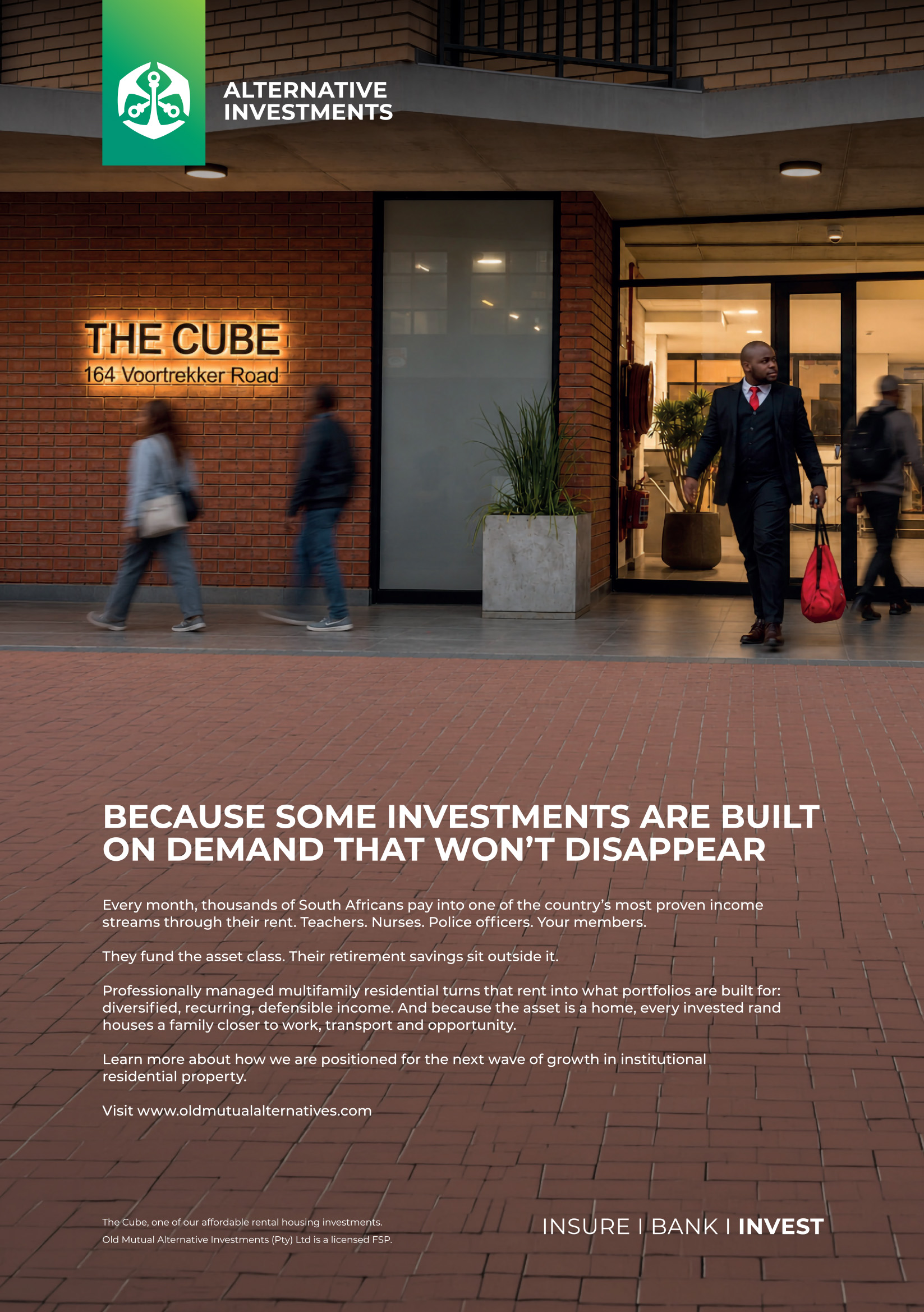
Maitland Metro in Cape Town shows what a bankable social infrastructure investment can look like when the fundamentals are right. The Cube is a 241-unit affordable rental development within the wider Maitland Metro precinct, designed to provide quality, well located housing at institutional scale. It sits within a broader precinct-led regeneration strategy in a well-connected urban infill area about 5 km from the CBD, with direct access to rail, bus and taxi routes as well as nearby employment nodes. Importantly, the investment was not underwritten on aspiration alone. The Prime, the first building in the precinct, had already been delivered on time and on budget and reached practical full occupancy within six months, giving us real evidence of tenant demand, achievable rentals and operating performance.
The result is a good example of how affordable housing can be structured as a commercially robust investment, with location, proven demand, experienced partners and disciplined execution doing the heavy lifting, while the social impact follows through better access to quality housing, jobs and more inclusive urban growth.
Strong demand, however, does not on its own make a social infrastructure project bankable. The structure still has to work. Developers need an economic incentive to continue delivering projects, operators need to be rewarded for maintaining performance, investors need an appropriate risk-adjusted return and the end user must be able to afford the product or service. When one of those interests becomes disconnected from the others, the economics of the investment are unlikely to remain sustainable over the long-term.
For that reason, governance and alignment should be central to how investments are structured. Capital should be deployed against realistic assumptions and measurable performance rather than optimism. Future phases must be linked to operating milestones, while governance rights and appropriate exit mechanisms will help ensure that the interests of investors and operating partners remain aligned over the life of the investment.
Importantly, many of the factors that improve the social outcome also strengthen the commercial performance of the asset. In affordable housing, rents that tenants can sustainably afford support collections and occupancy. Good management improves retention.
Safe, clean and well-maintained buildings support demand. Well located housing gives people better access to employment and transport while making the property more attractive to prospective tenants. Social value and investment performance can therefore reinforce one another when they are designed into the investment from the beginning.
Private capital can add particular value where it brings capabilities that are difficult to sustain through public funding alone, including rigorous underwriting, specialist operating expertise, long-term governance and the ability to support platforms through multiple phases of growth. Government still has an important enabling role through zoning, access to land, infrastructure provision and policy certainty, but an investment becomes more resilient when its fundamental economics are based on sustainable demand rather than being entirely dependent on a subsidy or policy intervention continuing indefinitely.
Our experience in affordable education shows that the same model can work beyond housing. The investment case rests on the same fundamentals we look for elsewhere in social infrastructure: sustainable demand, a capable operator, disciplined structuring and the ability to scale. None of this removes the risks associated with social infrastructure. Poorly selected locations, weak counterparties, development overruns, unsustainable pricing and uncontrolled operating costs can all undermine returns. In affordable housing, operating expenses are particularly important because increases in costs that cannot be recovered through rental income place direct pressure on the investment case. Long-term maintenance also has to be properly understood and provided for, while the quality of property management can materially influence collections, occupancy and asset performance.
The answer is therefore not to treat social infrastructure as inherently concessionary, but to apply the same level of commercial discipline expected elsewhere in institutional portfolios. Pension funds and other long-term investors still require appropriate financial outcomes and social purpose should never be used to justify unsustainable business models.
The opportunity is that, when these investments are structured and managed well, the financial return is achieved in addition to the provision of tangible social infrastructure assets; including dignified and affordable housing, operational schools and well-planned precincts that serve the people who live and work in the area for years to come. That outcome is created through financially sustainable assets, capable operators and investment structures designed to endure over time.