
Fees are one of those things that we, as South Africans, hate to talk about. Have you ever noticed that whenever a service provider is pitching for business, the slide about fees ends up being the very last slide? It also gets the least time and the least attention. Everyone awkwardly looks down at their shoes, waiting for someone else to ask a question. This will hopefully be the first in a series of articles that pose some thought-provoking questions about fees.
Unfortunately, fee structures in the retirement fund industry tend to be very complicated. This means we need to ask questions. You actually need an Excel spreadsheet to work out what you are paying! Very often, trustees are not fully aware of what they are paying for various services. Furthermore, fees often increase according to a formula, which means trustees are often unaware of how much their fees increase over time.
Different fee methodologies
There are three main methods used to charge fees in the retirement fund industry:
- Rand amount per member per month
- Percentage of assets
- Percentage of salaries
Each one of these methods can result in very different costs in the long run.
Future cost projections
Let us use an example to illustrate the above.
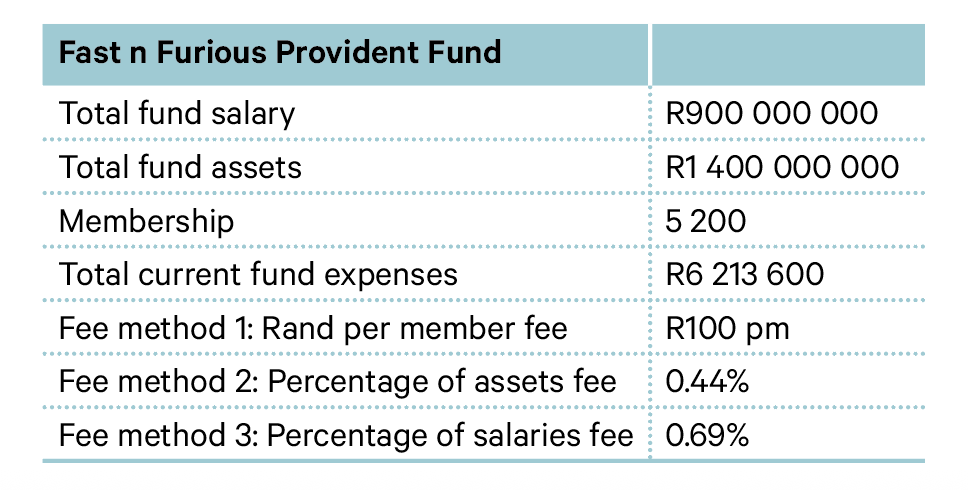
This fund has total annual expenses of R6.2 million. These costs can be charged using any of the three methods above. All three methods will give the same current costs. However, what can be significantly different is the future cost.
Each of the three methods of charging will result in different future increases.
- Fee method 1: Rand per member fee – The rand per member fee of R100 per month will usually increase with inflation. So, if inflation is 6%, then the total fees will increase by 6%.
- Fee method 2: Percentage of assets fee – The percentage of assets fee will increase by the investment return on the Fund. So, if the investment return on the Fund is 11%, then the fee will increase by 11%.
- Fee method 3: Percentage of salaries fee – The percentage of salaries fee will increase by the average salary increase across the Fund. So, if this is 7%, then the total fees will increase by 7%.
We can see that even in one year’s time, the fees that started out the same at R6.2 million will already start to look quite different.
A retirement fund is a long-term vehicle. It is meant to last for many years. So, let’s do a long-term, 40-year projection to see how different these fees will be in 40 years’ time.
First, we will need to make some assumptions:
- Inflation of 6% p.a.
- Salary increases of 7% p.a.
- Investment return of inflation + 5% = 11% p.a.
This is what we expect over the long-term: salary increases slightly higher than inflation, and investment returns in line with a typical investment target.
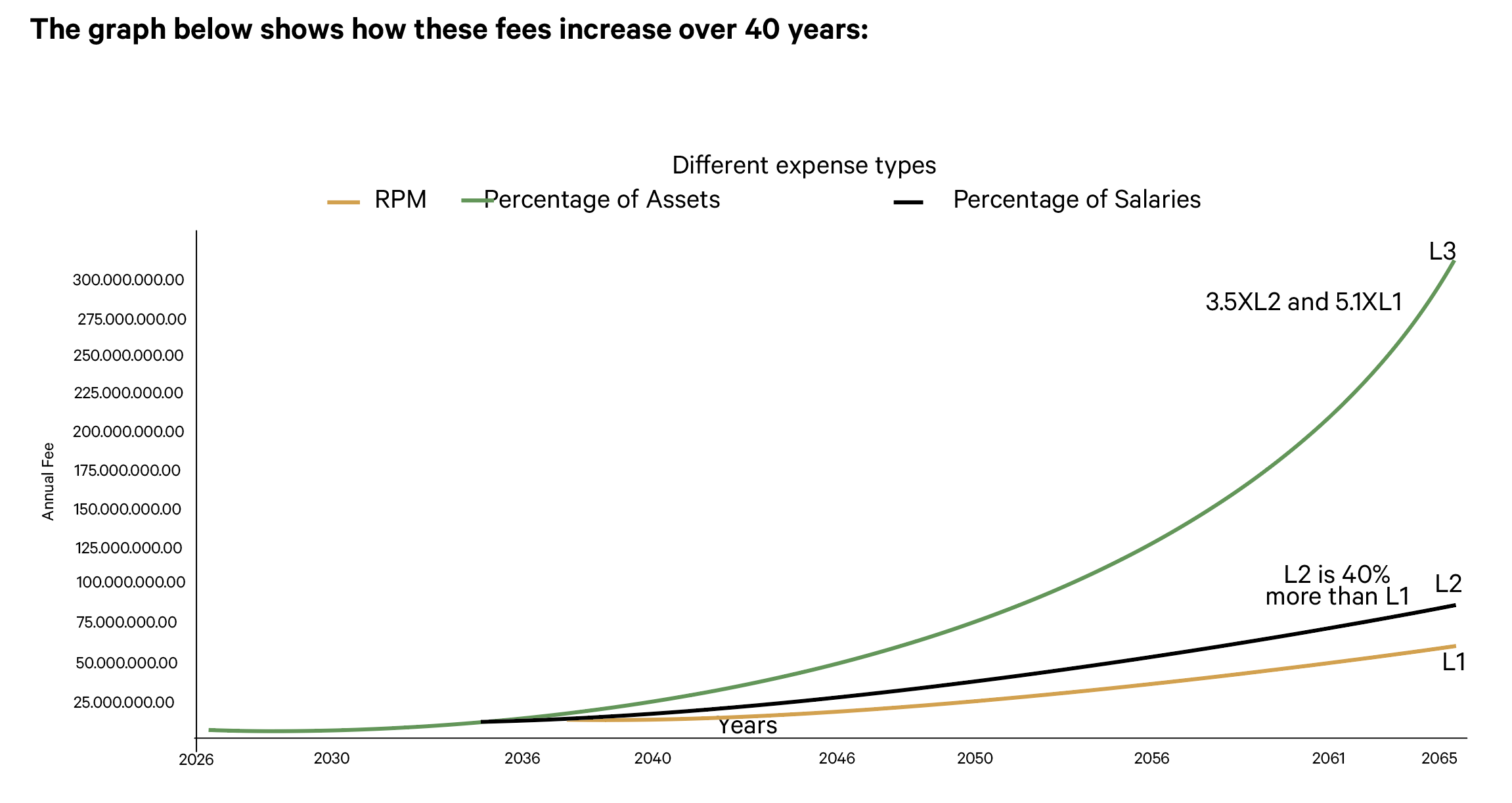
Our benchmark is inflationary increases, and these are shown as L1 in yellow in the graph. This is the rand per member fee.
The percentage of salary fee results in a fee that is 40% higher in year 40 than the rand per member fee.
The percentage of assets fee results in a fee that is 5.1 times higher than the rand per member fee. It also results in a fee that is 3.5 times higher than the percentage of salary fee.
This is a very big difference. Remember that all fees started at the same level. However, the percentage of assets fee grows to be 5.1 times the fee that grows with inflation.
We can therefore see that fees that start at the same level can grow to be very different in the future, depending on how those fees are charged.
Why is this important?
Let’s say we are doing a cost rebroke across different service providers. What if one of the service providers came in a bit cheaper, at around R6 million, versus R6.2 million for the other service providers?
What if the “cheaper” fee was a percentage of assets fee? That would mean that the fee would be cheaper now, but much more expensive in the future.
So, it is very important to look not only at current costs but also how we expect those costs to increase in the future.
Does this mean that the percentage of assets fee is automatically wrong? No. I can do other projections for different funds where the percentage of assets fee could be cheaper. However, the point is this: no matter how your fees are charged, trustees need to see current costs, historic costs and projected future costs to understand whether fees are appropriate for a specific fund.