

The global security environment is undergoing a profound transformation. As nations rush to modernise their militaries and replenish stockpiles, the defence sector has become a critical area of focus for investors.
The growing global need for defence
Few structural shifts in global markets over the past two years have been as consequential or as ethically complex as the resurgence of defence spending. For decades, defence budgets in developed economies were managed down as a post-Cold War peace dividend. That era is now over. The combination of the war in Ukraine, rising tensions in the Indo-Pacific, and a fundamental reassessment of
collective security arrangements in Europeand beyond has placed defence firmly back at the centre of government expenditure and capital allocation decisions.
This shift poses a question for investors: how does one capture exposure to a sector with compelling structural growth dynamics while maintaining clear ethical boundaries and credible stewardship commitments?
The scale of the spending shift
The year 2025 marked a historic turning point for global military expenditure. According to the International Institute for Strategic Studies (IISS), global defence spending reached a record $2.63 trillion in 2025, representing a 2.5% increase in real terms from the prior year. European spending is particularly notable: the continent now accounts for over 21% of the global total. As shown in the chart below. Goldman Sachs is expecting this to grow significantly going forward, and several NATO members are committing to sustained budgets of 3–5% of GDP in the years ahead – levels not seen since the Cold War
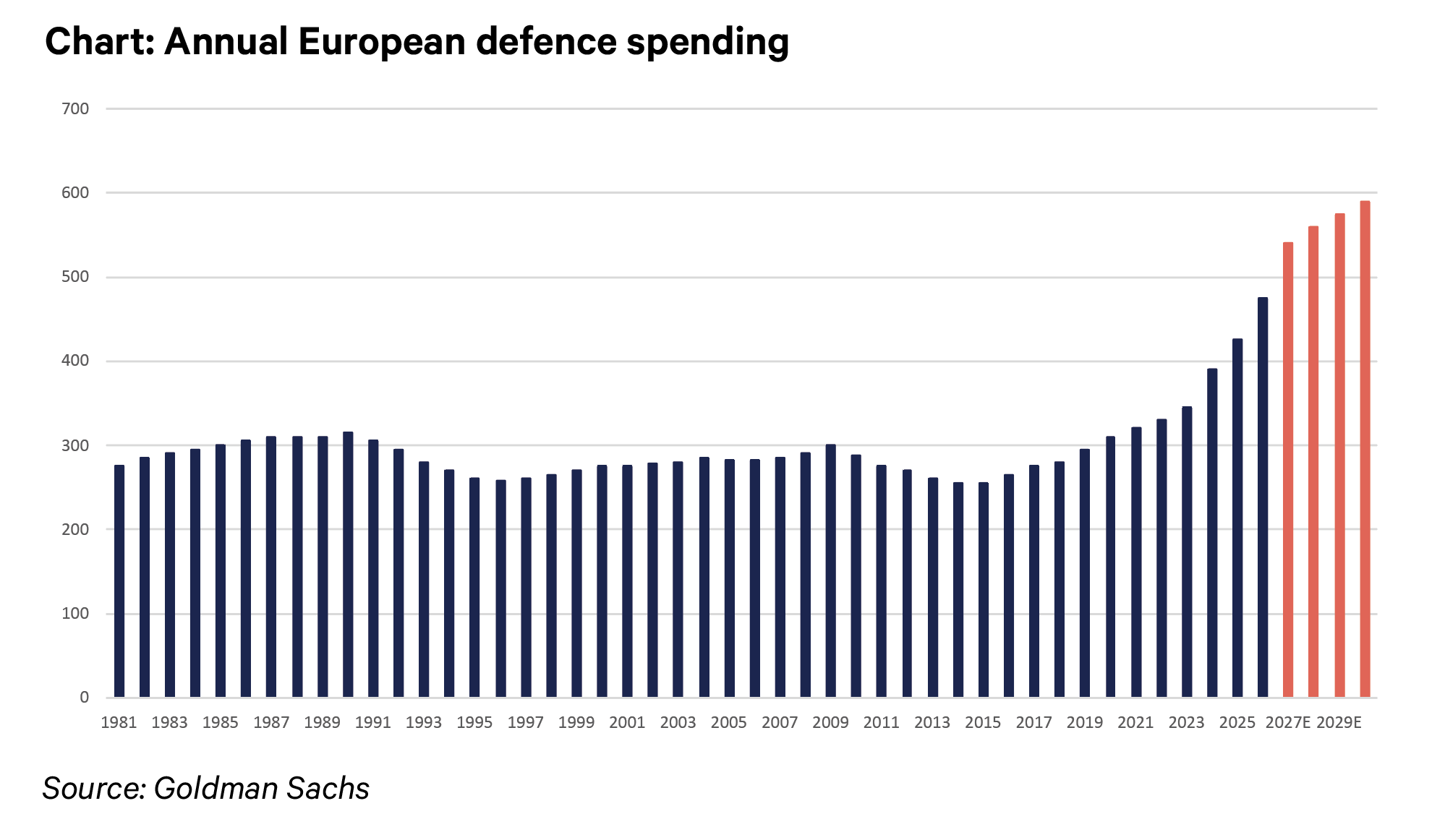
This is not a short-term procurement cycle. The structural drivers, including ageing equipment inventories, renewed competition for power, and the integration of advanced technologies, including AI, cyber capabilities, and systems into modern warfare, point to an extended period of elevated defence expenditure. The investment implication is a sustainable demand backdrop for defence-oriented industrial companies, particularly those with established positions in European procurement programmes.
Approaching an investment in defence
Many investors recognise that national security is a legitimate and necessary function of democratic governments, and that the companies that provide the industrial base for that security play an economically and strategically important role. However, investing in a growing defence sector of this nature requires a responsible approach. This approach could include:
Absolute exclusions: Avoiding certain companies operating in the sector for example those that manufacture controversial weapons (such as cluster munitions, landmines, and chemical or biological weapons). Given that NGOs and other human rights organisations tend to publicly flag when a company produces these products, the relevant companies can be identified.
Active monitoring: Actively monitoring companies that manufacture conventional weapons and nuclear-adjacent products.
Tracking controversies as part of ongoing monitoring includes assessing adherence to the United Nations Global Compact (UNGC) and evaluate alignment with the UN Guiding Principles on Business and Human Rights (UNGPs). Where controversies arise, assessing materiality, management response, and trajectory becomes important before determining whether continued ownership is appropriate.
The table below provides examples of companies operating in the defence sector highlighting how they would screen for exclusions and controversies:

Your content goes here. Edit or remove this text inline or in the module Content settings. You can also style every aspect of this content in the module Design settings and even apply custom CSS to this text in the module Advanced settings.
Conclusion: Principled exposure in a changing landscape
Looking ahead, it’s important to remain mindful of new challenges for the sector. The integration of artificial intelligence into weapons systems represents the most significant emerging ethical challenge. The evolving nature of warfare also requires investors to continually reassess policies and exposures.
The investment case for defence exposure is compelling. The ethical questions it raises are important and require active engagement rather than passive acceptance. An approach to combine absolute exclusions of controversial weapons, transparent disclosure of nuclear-adjacent holdings, and ongoing monitoring of controversies and compliance with norms should be designed to ensure defence exposure is principled, not opportunistic.
As the landscape changes, and in defence, it is changing rapidly, investors’ stewardship commitments should change with it.
