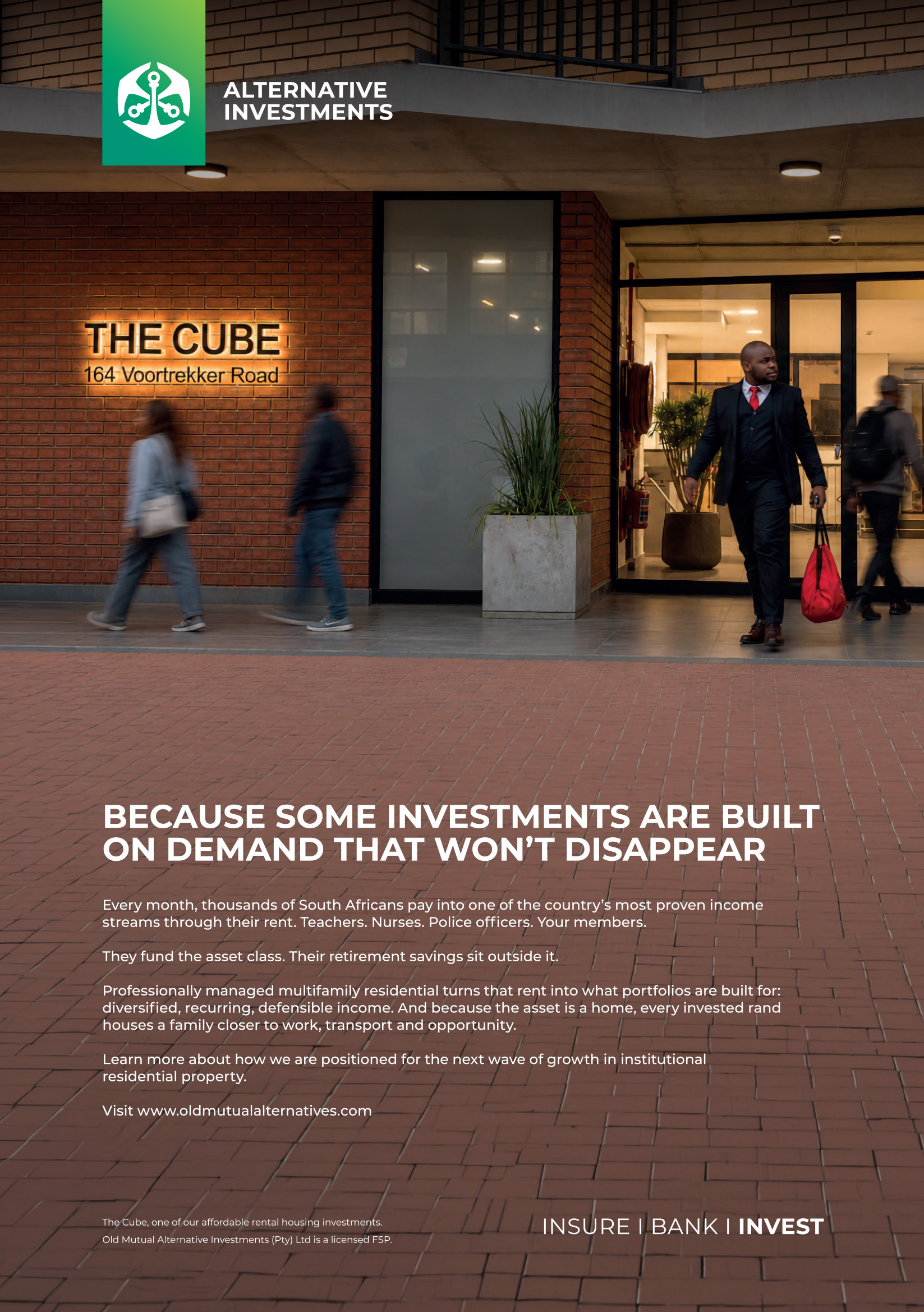
Residential rental is one of South Africa’s most familiar property markets, but it remains poorly understood from an institutional investment perspective.
Part of the misunderstanding comes from familiarity itself. Most people have rented a flat, owned a buy-to-let property, dealt with a landlord or formed an opinion about inner-city buildings. Those reference points can obscure the distinction between individual property ownership and institutional residential rental. The latter is not simply buy-to-let at scale. It is a professionally managed, long-term real estate asset class built around scale, data, operating discipline and tenant demand.
For pension funds, asset consultants, lenders and other long-term allocators, residential rental should be assessed as an operating platform, not a collection of individual flats.
The building is important, but the investment case is shaped by the engine behind it: how tenants are sourced and vetted; how vacancies and collections are managed; how maintenance is planned; how costs are controlled and how quickly units can be re-let without compromising the tenant experience.
This is where the sector is still often underestimated. Residential rental has many tenants, shorter leases and higher day-to-day operational intensity than more familiar property sectors. To some investors, those features have historically looked like risk.
In practice, scale can turn perceived risk into resilience. A residential portfolio with thousands of tenants is not dependent on one retailer, one office occupier or one industrial tenant. Its income profile is spread across a large and diverse tenant base. People typically cut back on discretionary spend before they stop paying for a place to live. Tenants may have the ability to more frequently, but a mature operator is built for maximising retention.
In residential rental, asset management and property management cannot be treated as afterthoughts. Safety, cleanliness, amenities, proximity to transport, access to work opportunities and responsive management all influence demand, retention and rental growth. The tenant experience is therefore part of the investment case.
Affordable and well located rental housing is often framed mainly through its social value. That value is real. South Africa’s spatial history means that where people live still shapes access to work, transport, schools, services and economic opportunity. Quality rental housing close to urban centres and transport routes can improve daily life while also supporting a more investable housing model.
But the impact case should not obscure the investment case. Pension funds are investing on behalf of members who need long-term financial outcomes. Residential rental has to stand up commercially. Its relevance lies in its ability to combine essential social infrastructure with a credible and stable income generating profile.
The return story is not about spectacular short-term growth. It is about stability, demand, income and disciplined execution over long periods. In a market where investors are looking for predictable cash flows and support for inflation-linked liabilities, residential rental deserves closer attention. It offers exposure to a basic need, supported by long-term demographic and urbanisation trends.
One barrier to institutional allocation has been the perception that there is not enough information to assess the sector properly. In reality, many operators and investors have been active in residential housing for a long time. The challenge is not only data availability, but data consolidation. Performance data, vacancy trends, arrears, rental growth and cost ratios need to be presented in a way that allows investors to compare residential rental with other property sectors on a like-for-like basis.
If residential rental is to become a larger part of institutional portfolios, investors need to understand how the sector behaves through cycles, how it compares with other property sectors and how returns are generated across different locations and income bands. Better data can help investors separate weak assets from strong platforms, isolated projects from scalable portfolios and perceived risk from actual risk.
Another misconception is that residential rental is too niche to absorb institutional capital. The market is still relatively small compared with more established property sectors, but it is growing. Demand is not the binding constraint. The harder questions are around access to suitable land, conversion opportunities, planning risk, construction costs, capital structures and the ability to aggregate assets at scale.
For institutional investors, the opportunity is not only in individual developments, but in platforms capable of scaling quality rental housing over time.
As the sector matures, financiers are gaining comfort with the operating model. Early concerns around short leases, rent collection, tenant churn and arrears are being tested against actual portfolio performance. Lenders and investors are increasingly looking at asset quality, location, demand, tenant management, cost control and track record.
Residential rental will not solve South Africa’s housing challenges on its own. It will not suit every investor, city or capital structure. But it should no longer be dismissed as informal, unproven or too operationally complex for institutional capital. The same operational intensity that can make the sector difficult to understand is also where value is created when the right platforms are in place.
South Africa needs more quality rental housing in well located areas. Investors need long-term assets that can generate