

A positioning dilemma for asset allocation: why rising concentration and shifting stock-bond correlations are changing the diversification math for multi-asset portfolios.
A handful of shares now set the tone
One of the biggest challenges for global emerging-market funds is the growing concentration within the equity benchmarks they track. TSMC, Samsung Electronics and SK Hynix have rallied 128%, 352% and 636% respectively over the past 12 months to June 2026, and now account for roughly 29% of the EM index.
At that weight, managers are effectively forced into an underweight position on stocks they may fundamentally like. The same names dominate their home markets: TSMC alone is about 42% of Taiwan’s market, while Samsung and SK Hynix together make up 55% of the
Korean index. The Hang Seng and S&P 500 are similarly concentrated, with their top ten constituents accounting for 51% and 36% of each index respectively.
This is not new to the South African JSE. The historic rally in Naspers led to the creation of the Capped SWIX, so that managers could still achieve adequate diversification.
Key Insight
Concentration risk intensifies sharply once a single sector nears 20–30% of an index, absorbing a disproportionate share of the tracking-error and risk budget.
Meanwhile, South African investors face a dollar-debasement theme, which has fuelled a rally in commodities as the dollar has weakened, particularly precious metals. The PGM and gold sectors alone accounted for 20% of the index at their peak, though this has since moderated to around 13% (Figure 1), since the start of the US–Iran conflict at the end of February.
In the local market this is exacerbated by two further factors. Financials dominate, with banks at around 20% of the index; individual banks may carry their own idiosyncratic fundamental drivers, but their returns are highly correlated. Naspers and Prosus, despite index capping, still represent a combined 12% of the JSE SWIX.
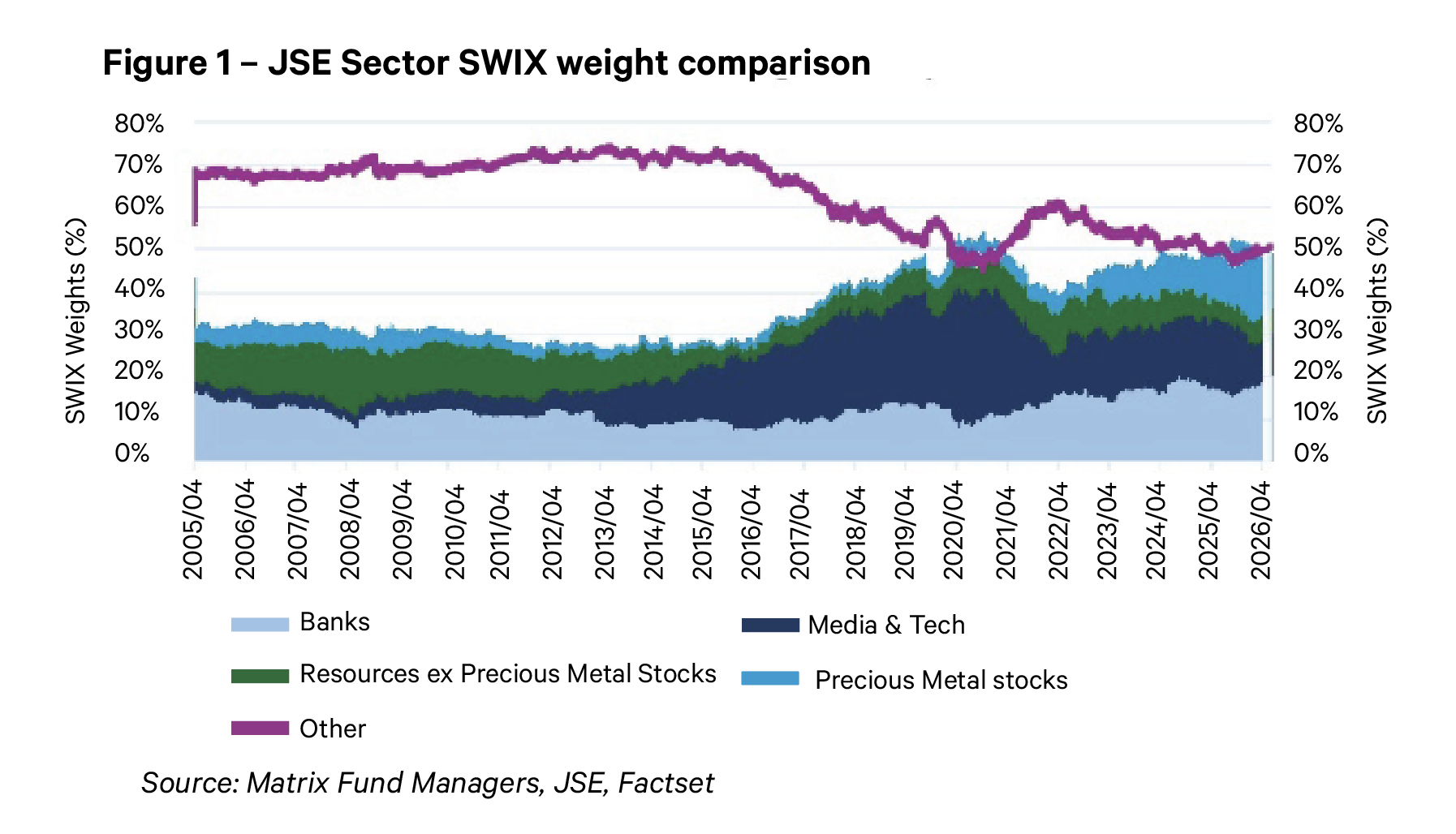
Taking active risk here introduces unintended exposures, while mandate constraints such as a 10% single-issuer cap can compel managers into constrained, often suboptimal, positions, ultimately undermining the diversification of pensioners’ savings, especially where mandates require beating the benchmark over the short term. For asset consultants assessing manager quality, single-stock and single-sector concentration is now central to any risk-budgeting conversation, not a side issue to be raised only when performance disappoints.
Bonds have stopped cushioning the fall
Stock-bond correlations have also shifted. In most major recessions and deflationary panics, bonds offset a large part of equity losses: during the dot-com crash, the global financial crisis and the 2020 sell-off, bonds rallied as central banks cut rates. But in the 2022 inflation shock the opposite happened: rate hikes drove bonds and equities down together, leaving multi-asset funds with nowhere to hide, a dynamic not seen persistently since the 1970s.
South African equities and bonds have been positively correlated in most periods, reflecting the resource-driven nature of the market. A commodity rally typically lifts the equity market, improves the terms of trade, strengthens the currency and supports bonds.
But the same circular dynamic works in reverse, diminishing the traditional diversification cushion. This creates a further dilemma for asset allocators today, with inflation remaining sticky, currently exacerbated by oil prices amid the US–Iran conflict, which has pushed global bond yields higher.
What it means for your pension money in multi-asset mandates
Strategic asset allocation is widely used to evaluate active decisions, offering historical guideposts for what has worked across different market cycles. However, its assumptions rely on portfolios being sufficiently diversified, an assumption that may no longer hold. Rising concentration and higher equity-bond correlation make it harder for active managers to beat benchmarks in the short term.
“Managers must hold to their philosophy: ensuring genuine diversification and relying on the multiple return drivers of a multi-asset portfolio.”
While benchmarks remain useful for evaluating multi-asset managers, an excessive focus on short-term outperformance against an increasingly tilted equity index can expose retirement capital to unnecessary risks: risks that prudent stewardship of capital should avoid. For trustees, this means reading peer- and benchmark-relative performance alongside absolute risk and diversification metrics, particularly where mandates are judged only against increasingly concentrated indices over short measurement periods.
Since strategic asset allocations are built on historical cycles, managers must hold to their philosophy: ensuring genuine diversification and relying on the multiple return drivers of a multi asset portfolio.
