

Little of this quarter’s news is genuinely new law for retirement funds. It is more a shift in how the existing rules are enforced, and a reminder from both the courts and the Adjudicator that accountability only counts when it lands on the right person and is properly reasoned.
The growing cost of non-compliance
Unpaid contributions: who is personally liable
The scale of employer non-compliance with section 13A of the Pension Funds Act (“the PFA”) is impossible to ignore. In its most recent list of defaulting employers, published on 30 June 2026, the Financial Sector Conduct Authority (FSCA) put the arrears at R8.33 billion, owed to around 590 000 members, with late payment interest a growing share of that total. The Office of the Pension Funds Adjudicator (PFA) has been equally blunt, describing the level of section 13A breaches as a crisis, pointing out that arrear contribution complaints now make up more than half of his office’s caseload.
A dedicated complaint form
Against that backdrop, the PFA has introduced a complaint form for funds lodging section 13A complaints against participating employers and responsible persons. The form is more than an administrative convenience. It requires funds to:
- identify the responsible person/s,
- attach a reconstruction schedule showing the periods of non-submission and non-payment,
- produce the section 13A(9)(a) notice to the employer, and
- quantify the outstanding contributions and interest.
hese complaints are to be handled under the PFA’s expedited process. The effect is to move the discipline of proper identification to the front of the file, where it belongs.
Why that matters was illustrated, in the same quarter, by the Financial Services Tribunal (“the Tribunal”).
Naming the right person
Financial stress frequently affects employee engagement, productivity and mental health. As financial planning professionals, we understand that financial wellbeing extends far beyond retirement savings. Employees need support across their entire financial journey, including budgeting, debt management, risk protection, retirement readiness and long-term financial resilience.
This creates a valuable opportunity for financial planners to contribute meaningfully within employee benefits environments. By helping employees develop healthier financial behaviours, financial planners can support broader organisational wellbeing objectives while improving individual financial outcomes.
The lesson for funds and administrators learnt in Moodley v Transport Sector Retirement Fund and Others, is that the responsible person’s name supplied by an employer does not, on its own, create liability. Before pursuing a personal liability claim against an individual, funds should satisfy themselves that the person falls within the category of persons contemplated in section 13A(8). In the case of a company, this means a director who is regularly involved in the management of the company’s overall financial affairs.
Ignore the PFA at your peril – a sharper instrument on the horizon
The consequences of non-cooperation with the PFA’s requests for information or responses may soon go further. Section 30J of the PFA permits the Adjudicator to adopt any procedure he considers appropriate in conducting an investigation, and applies certain provisions of the Commissions Act, 1947 to that investigation. The Adjudicator has obtained a senior counsel opinion confirming that these provisions empower him to issue summonses and subpoenas, under the Commissions Act, against funds and administrators that fail to respond, directed at the principal officer and the chairperson of the board. Defying such a summons or subpoena is a criminal offence, enforceable through the criminal justice system and through civil contempt proceedings.
The courts hold funds to their duties
The courts spent the quarter insisting that funds exercise their powers for the right purpose and on proper reasoning.
The twelve-month duty to trace
In South African Retirement Annuity Fund v Pension Funds Adjudicator and Another, the court rules that the twelve-month period runs from the point at which the fund becomes aware of the death, not from the date of death itself, because the duty to trace and investigate can only arise once the fund knows there is a death to investigate.
Reasoning the allocation
In Nel v Allan Gray Retirement Annuity Fund, the Adjudicator ruled that dependency is fixed as at the date of the member’s death, although later changes in circumstance may inform the equitable allocation.
What the Regulator is planning next
In July 2026 the FSCA published its three-year Regulation Plan, covering 1 April 2026 to 31 March 2029. The COFI Bill sits at its centre; the Bill was introduced to the National Assembly in April 2026 and is now in the early stages of the parliamentary process. Beyond that, the Plan signals restraint: while the transition is under way, the FSCA intends to limit new projects and to fold existing instruments into the emerging frameworks rather than replace them piecemeal. Pension Fund Circulars 86 and 90, which govern member disclosure, and Directive PF No. 8, which prohibits fund officers from accepting gratification, are expected to move into the conduct and governance frameworks on that basis. The snapshot below sets out what the FSCA will focus on over the period:
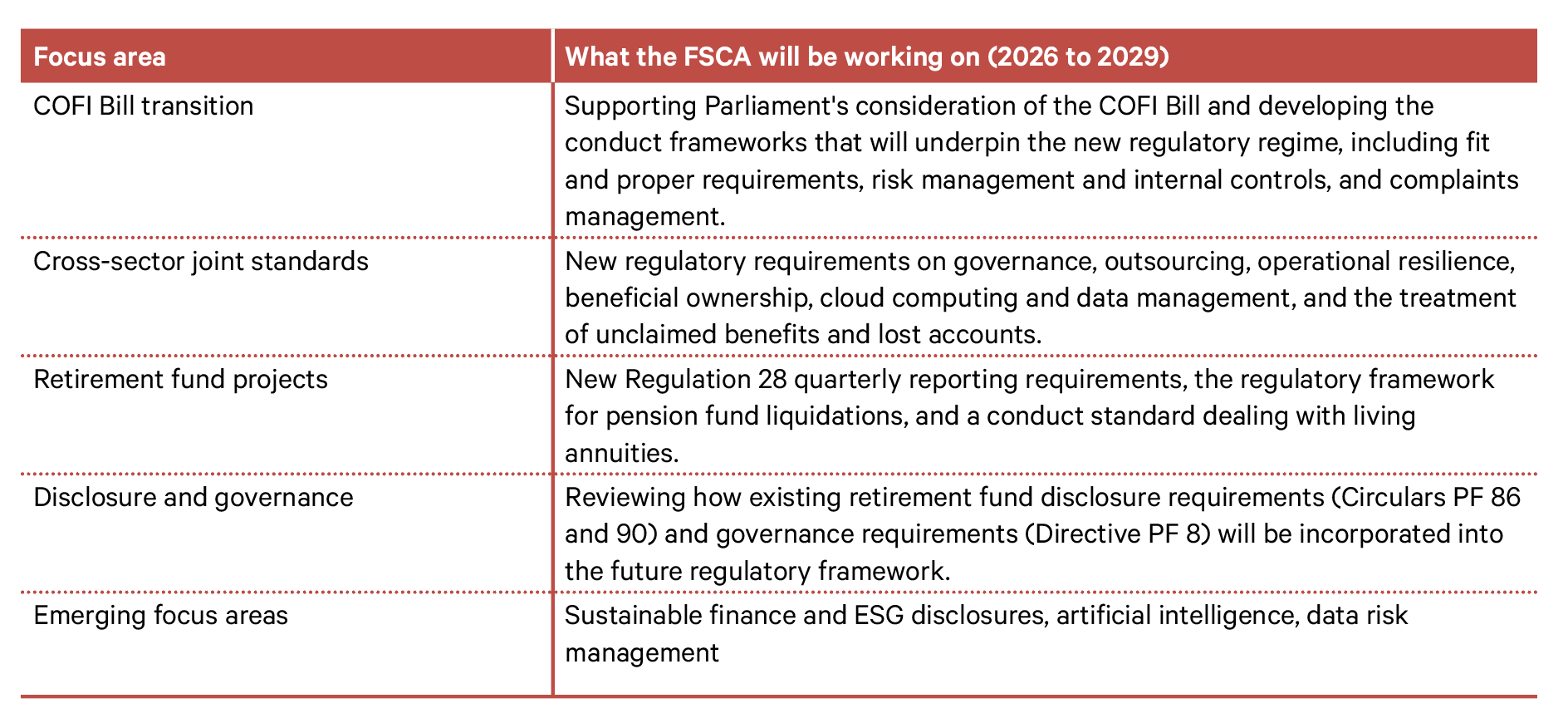
For retirement funds, the Plan adds no new projects.