

In retirement planning, one proverb holds the ultimate truth: “The best time to plant a tree was 20 years ago. The second-best time is today.” A sustainable retirement is not luck; it’s the result of three key decisions.
1. When: The cost of delay
Time is your greatest multiplier. Consider two investors targeting a 10% p.a. return with a R7,500 monthly contribution:
- Early starter (age 25): Reaches age 65 with approximately R43,9 million.
- Late starter (age 35): Reaches age 65 with approximately R16,4 million.
By delaying one decade, the second investor loses nearly two-thirds
of their potential wealth. In the world of compounding, “waiting for the right time” is the most expensive decision you can make.
2. How much: The 15% benchmark
The gold standard for a comfortable retirement is contributing 15% of your gross income. While investment growth is vital, it cannot rescue a portfolio that is fundamentally underfunded. If you have started late, your primary recourse is to aggressively increase this percentage now.
3. Where: Portfolio returns
Where you “plant” your capital determines its resilience. A 3% underperformance, driven by high fees or poor fund performance, can destroy as much wealth over 40 years as starting a decade late.
While most active funds trail their benchmarks*, passive funds also underperform their benchmarks due to fund costs. The goal is to build a portfolio that outperforms its benchmark after all fees. This complexity is where financial advisers and discretionary fund managers earn their keep – building the right portfolio to ensure your retirement tree thrives.
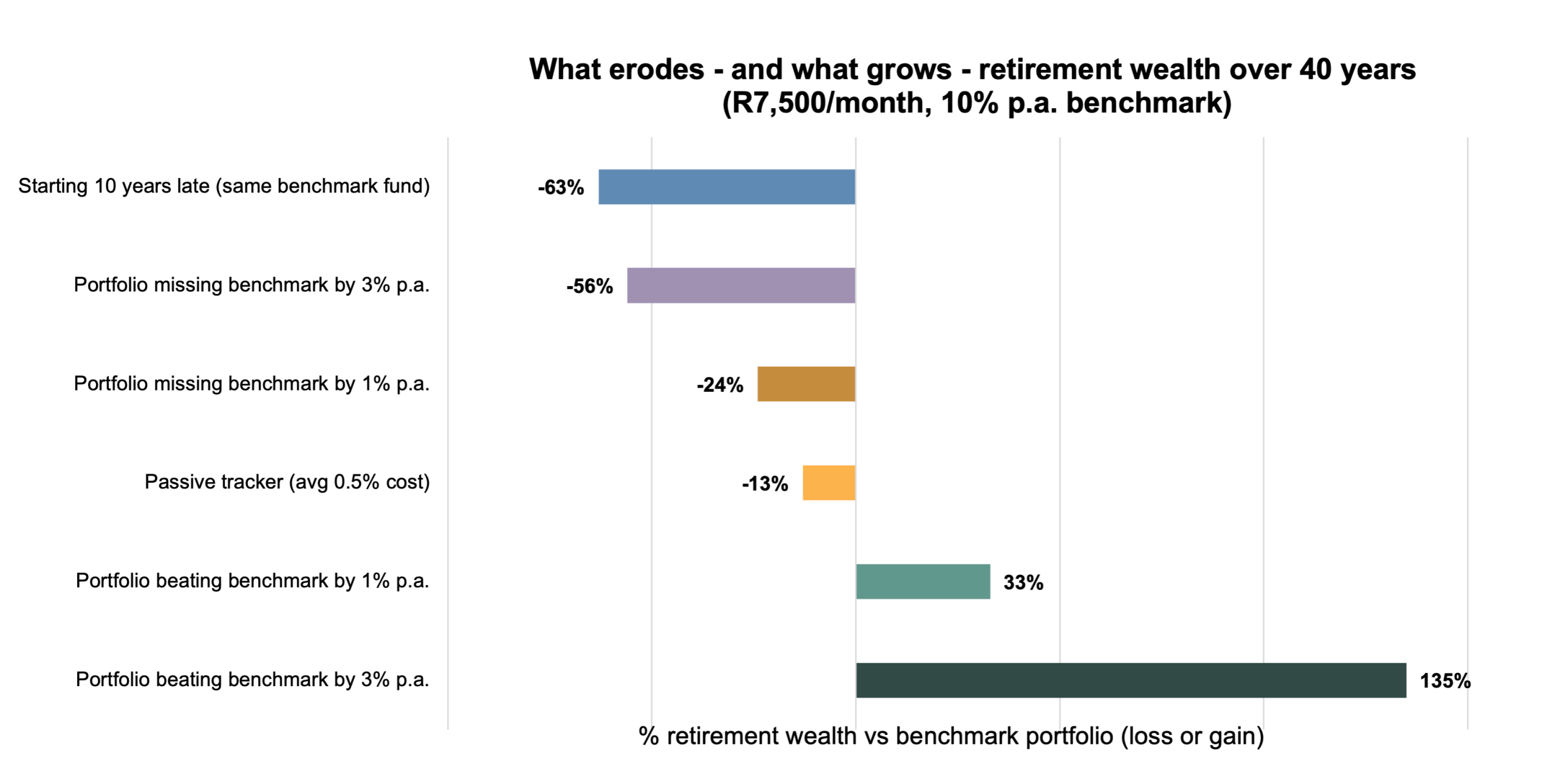
Source: Fairtree. R7,500/month (15% of a R50,000 salary) invested in a retirement annuity for 40 years. Negative bars show wealth lost vs. the benchmark; positive bars show wealth gained.
A retirement tree grows slowly, almost invisibly at first. But for those who plant early and nurture consistently, its shade can last decades. Start today, save sufficiently and build a robust portfolio to ensure a comfortable retirement.
*https://www.spglobal.com/spdji/en/spiva/article/spiva-south-africa/
