
As of 24 April 2026, the US–Iran conflict has been ongoing for approximately eight weeks. Despite President Trump’s extension of the ceasefire to allow for further negotiations, the path to a lasting resolution remains uncertain. Regardless of when and on what terms this most recent conflict may ultimately end, it has exposed a rise in global macroeconomic risks. Most importantly, it has highlighted the fragility of global oil supply and intensified the debates surrounding how central banks should respond to the knock-on effects of higher energy prices on global trade and inflation.
Locally, these debates appear more intense, as the market grapples with how the South African Reserve Bank may respond to these dynamics, and what that response could mean for investment and economic growth. At a micro level, the potential implications are stark. The combination of higher borrowing costs and lower disposable income presents a significant risk to an already over-stretched consumer. At the same time, lower investment, subdued growth and the rising prominence of AI may compound South Africa’s challenge of high unemployment. Against this uncertain macro-economic backdrop, what are the implications for private credit, an increasingly prominent asset class within the private markets?
Developed markets: facts over headlines
From a developed market perspective, private credit has taken centre stage in recent months. Rising investor redemptions, growing concerns over the quality of underlying loans and the asset class’s overall exposure to software companies, which are vulnerable to AI disruptions, have intensified the debate around the trajectory of the asset class. There is also increased speculation about whether these risks could spill over into the broader financial system. Amid the market noise, it is important to focus on the facts to establish a clearer view and to assess how these risks may impact the asset class.
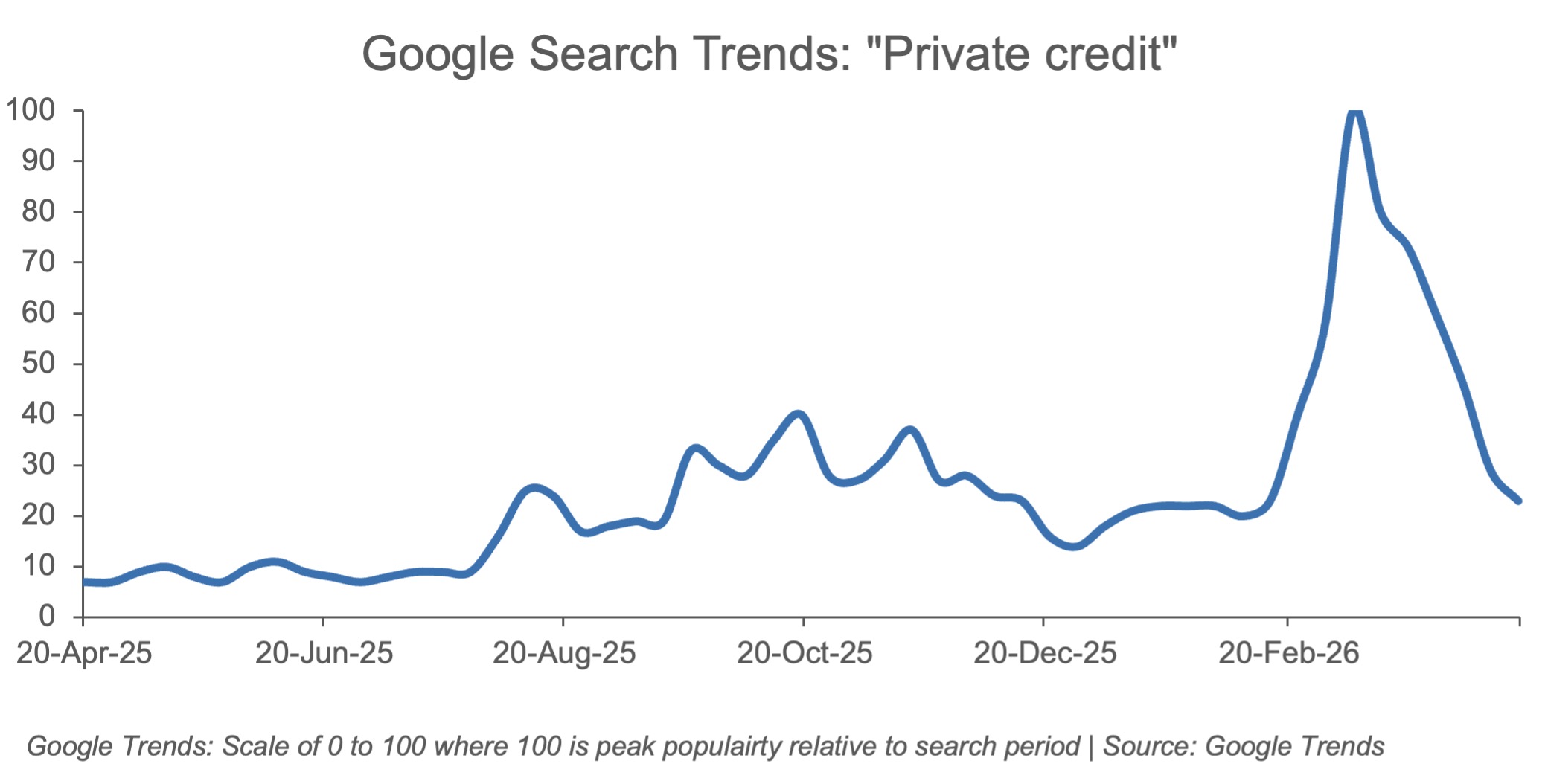
Fitch Ratings reported a default rate of 9.2% in 2025, up from 8.1% in 2024, based on its US Privately Monitored Rating (PMR) portfolio, which provides a useful proxy for the health of the US private credit market. It remains unclear whether the rise in default rates is linked to weak credit decision making, less resilient business models amid more challenging conditions, fraud and corporate governance failures (as highlighted by the recent Tricolor default) or a combination. Regardless, these trends emphasise the importance of a disciplined investment process, a focus on resilient borrowers, and robust corporate governance at a borrower level. These factors are not only relevant during heightened market uncertainty, but are also applicable to the South African market.
JP Morgan estimates that US private credit funds’ exposure to the software sector stands at approximately 21% and rises to 40% when broader technology and business services are included[1]. This level of single sector exposure is significant enough to cause concerns about the potential threat that AI poses to software and tech companies, and by extension their ability to repay private credit loans. While comparable sector exposures are not readily available, and AI adoption remains in its infancy in South Africa, the implication for local investors remains clear: ensure that managers are well diversified across resilient sectors and robust individual borrowers.
Systemic risk in perspective
While contagion during market meltdowns can turn non-linear, the underlying financial interconnectedness needs scrutiny. The fact that bank and non-bank lenders’ exposure to private credit (estimated at US$410bn – US$540bn in 2024) constitutes a small share of their total assets (estimated at a combined US$127tn)[2] makes the systemic risk posed by rising private credit defaults more benign than what current headlines suggest. It is difficult to pinpoint a single reason for recent investor redemptions in developed markets and to therefore write off private credit as an asset class. Perhaps a more balanced approach is to consider the interplay of these complex factors: global macroeconomic uncertainty, a preference for more liquid lower-risk assets, single-sector risk, and a stronger focus on credit quality – both historically and on a forward looking basis.
[1] J.P. Morgan Global Alternative Investment Solutions, latest available as of April 2026
[2] Financial Times, “Who cares if private credit goes kaput?” 18 March 2026

South African opportunity: selectivity is everything
Locally, macroeconomic uncertainty may constrain deal flow and make high quality origination harder. When downside risks are elevated, the ability to source “gems amidst the rubble” becomes the decisive differentiator.
The managers who will stand out are those with:
- deep networks inside South Africa’s entrepreneurial ecosystem;
- proven skill in identifying business models that can grow even in weak conditions;
- genuine partnerships with management teams; and
- rigorous portfolio construction that treats diversification and risk management as core disciplines rather than afterthoughts.
Strategic takeaway
Geopolitical shocks, shifting trade patterns and inflation risks have not diminished the structural appeal of private credit; they have reinforced the importance of active, disciplined management. In South Africa, where public market liquidity can be constrained and economic cycles are pronounced, a well selected private credit allocation offers both income resilience and genuine portfolio diversification.
For investors, the key is clear: focus on managers who combine rigorous credit discipline with local origination edge. In uncertain times, that combination remains one of the most reliable sources of alpha in private markets.