

The investment landscape has changed
Companies are staying private for longer, and many businesses that would once have listed on public markets now remain private throughout much of their growth journey. As a result, a growing share of innovation and value creation is taking place beyond the reach of traditional stock exchanges.
This shift is prompting investors to look beyond listed markets in search of new sources of return and diversification. Even though private markets can feel unfamiliar, illiquid and complex compared to buying shares on a stock exchange, they are increasingly becoming part of mainstream portfolio construction.
The reasons are compelling. Historically, private equity has delivered attractive long-term returns relative to public markets, particularly for investors able to access high quality investment managers.
For decades, some of the world’s most sophisticated investors, including endowments, family offices and sovereign wealth funds, have allocated meaningful portions of their portfolios to private markets. Increasingly, individual investors are beginning to follow suit. In the US, regulators have begun opening the door for individual investors to gain exposure to private markets through their retirement savings. The direction of travel is clear: private markets are becoming more accessible.
The opportunity beyond public markets
The growing relevance of private equity reflects a broader structural shift in capital markets. Over the past two decades, the number of listed companies has declined across many developed markets, while the number of private companies has expanded significantly. Today, unlisted companies outnumber listed companies by approximately 3,000 to one.
Many businesses are now able to raise substantial amounts of private capital, allowing them to remain private for longer and continue growing outside public markets. In some cases, companies may never list at all.
For investors focused exclusively on public markets, this means an increasing portion of the investment universe is simply inaccessible. Some of the most attractive growth opportunities may be created, developed and realised before a company ever reaches a stock exchange.
A rare opportunity is emerging in US private equity
The US private equity market is currently benefiting from a unique combination of structural and cyclical factors. A generational wave of Baby Boomer business owners approaching retirement is creating a substantial pipeline of established, profitable businesses seeking succession solutions. This so-called “silver tsunami” is expected to drive elevated transaction activity for years to come, particularly in the lower middle market, where many founder-owned businesses are preparing for ownership transitions.
At the same time, the private equity industry is working through a significant backlog of unrealised investments. According to Bain & Company’s Private Equity Outlook 2026, an estimated US$3.8 trillion of portfolio company value remains unsold, while distributions to investors have remained near multi-year lows. This has contributed to a growing pool of secondary opportunities and increased pressure on some managers to realise assets.
For investors with capital to deploy, these conditions may create attractive entry points. Combined with the long-term structural growth of private markets, the current environment is presenting opportunities that may not be available under more typical market conditions.
Diversification benefits
Private equity, private debt and real estate can introduce sources of return that differ from those available in traditional equities and bonds. Global private market allocations can also enhance geographic and currency diversification, helping investors build more resilient portfolios over the long-term.
Research by J.P. Morgan, based on portfolio returns dating back to 1998, found that portfolios incorporating alternative assets delivered higher returns with lower volatility than comparable portfolios invested solely in public equities and bonds, as shown in this graph:
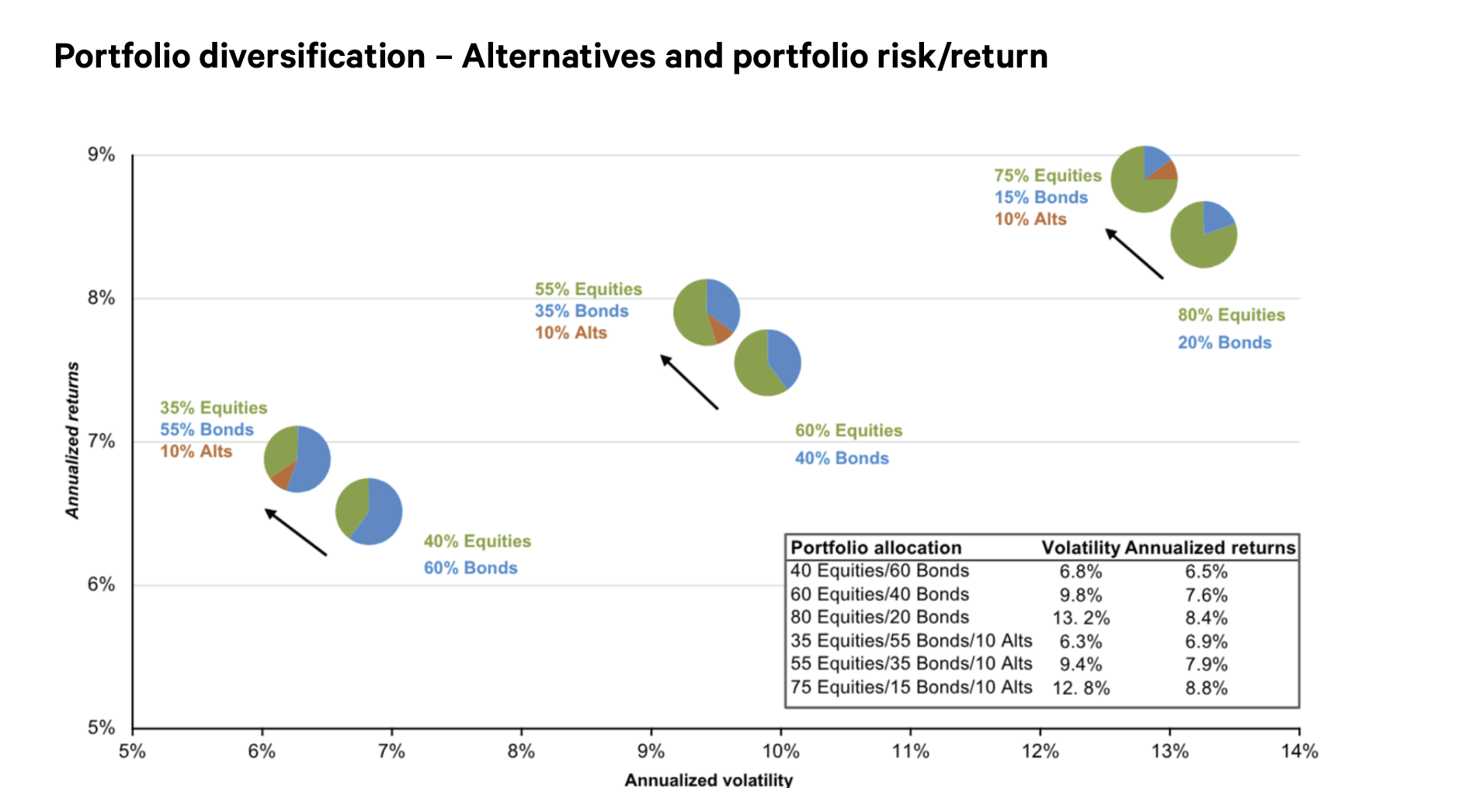
As a result, investors increasingly view private markets not merely as a return enhancing allocation, but as an important component of a broader portfolio construction framework. They can help support long-term objectives such as capital growth, inflation resilience and diversification across multiple economic environments.
Access matters as much as allocation
While the investment case for private markets is compelling, gaining exposure is often easier said than done. Building a diversified private equity portfolio independently typically requires significant capital, specialist expertise and access to managers that may be closed to new investors. Investors must also navigate legal structures, administration requirements, tax considerations and ongoing capital commitments. As a result, implementation can become one of the biggest hurdles for investors seeking private market exposure.
This is where the choice of asset manager is critical, particularly those with the experience, networks and capabilities to identify, assess and facilitate access to high quality private market investments on behalf of investors.
