

The business case for sustainability is clear: companies and retirement funds cannot thrive on a planet suffering from cascading crises and unmanageable risks. Yet, despite decades of corporate commitments, businesses continue to damage the planet. The environmental, social and governance (ESG) agenda has not delivered broad-based sustainable change and, in its current form, arguably it never will.
Is it time to confront the uncomfortable truth? ESG as it stands ‒ grounded in input disclosures and voluntary market action ‒ will not deliver the necessary change.
Is the solution a radical shift towards measurable impact?
Understanding the difference between ESG and impact
In an increasingly complex sustainability environment, we tend to use many concepts interchangeably. It is, however, important to distinguish between them to ensure informed decision making.
ESG is the environmental, social and governance factors, primarily the risks and opportunities that affect on a company’s financial returns. Importantly, it focuses on inputs: for example, whether a company has a board diversity policy and reports against it, or whether it has net zero targets. It does not measure the actual outcomes or real-world impacts informed by implementation or effective execution. The other terms used in the context of ESG is single or financial materiality, also known as the outside-in perspective.
Impact, on the other hand, considers the outcomes of business activities, the real-world effects, whether positive or negative. In impact, tracking direct outcomes is key.
Impact investing focuses on selecting projects or businesses that aim to make a positive difference in society or the environment, while also focusing on returns. Unlike traditional investing, it combines financial performance with meaningful change. Importantly, it goes beyond integrating ESG factors into the assessment of financial risk, but it enables positive change through investment decisions, whilst still delivering financial returns.
The last important concept in distinguishing between ESG and impact is that of double materiality. Double materiality provides a more holistic sustainability lens by focusing both on the traditional investor-centric perspective of how sustainability factors impact a company and its financial prospects (single or financial materiality), and on how the company itself impacts society and the environment (impact materiality).
ESG ratings tell us a positive story
The historic disproportionate attention to ESG alone has undoubtedly created a false sense of comfort – the belief that focusing on ESG automatically leads to a more sustainable world.
Arguably, ESG ratings have contributed to this perception. After all, if a company receives an AA or AAA rating, it must be sustainable and making a positive impact, right? Yet ratings do not measure effectiveness or impact at all, and they vary widely in methodology, which can mislead stakeholders about a company’s true sustainability performance.
Younger generations prioritise impact
Research confirms that gen Zs and millennials are interested in the outcomes of their investments beyond financial returns. They believe they can enable positive change through their investments.
What’s more, as employees, they want to work for organisations whose values and purpose align with their own.
The role of regulation
Various global regulations, frameworks and standards are increasingly requiring a double materiality lens.
In South Africa, the King Codes (King III and IV) were inherently based on double materiality, but King V makes it explicit.
The JSE Sustainability Disclosure Guidance also adopts double materiality, emphasising both outcome and impact metrics, not just financial or input-based measures.
In the recent Alexforbes, CIPC and dtic national survey on sustainability reporting practices and sentiment in South Africa, several respondents confirmed that they already report against frameworks using a double materiality lens. There was also strong support for any mandatory sustainability reporting to be based on double materiality.
The survey also explored who should be subjected to mandatory sustainability reporting, and general sentiment suggested publicly accountable organisations or those of systemic importance, specifically including large retirement funds. It is likely that, in addition to current voluntary standards, future mandatory sustainability reporting requirements will play an increasingly prominent role in the transition from single to double materiality.
What does measuring impact look like for a retirement fund?
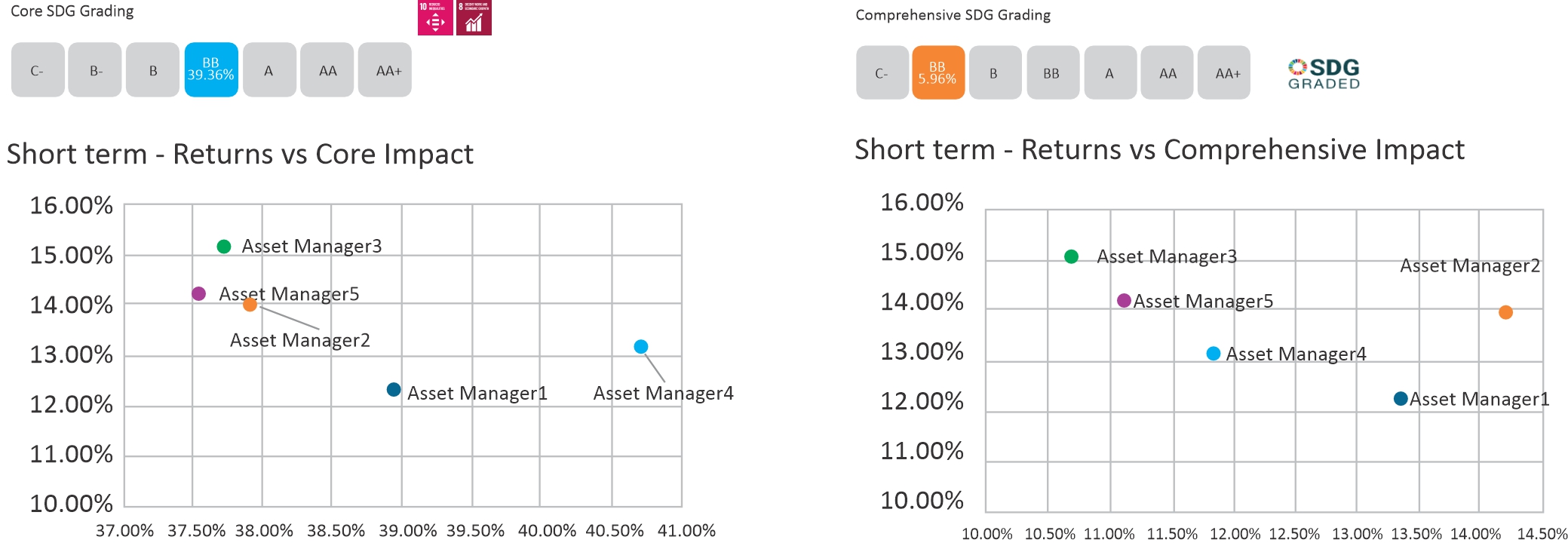
The graphs above show an example of impact reporting for a retirement fund. It is based on a real portfolio, illustrating the actual return and impact performance of the asset managers represented in the portfolio.
On the Y-axis, the graph denotes return over a one-year period, and on the X-axis, impact. And the United Nations Sustainable development goals (SDGs) are used as the impact lens.
The impact performance is shown based on core SDG and comprehensive SDG gradings: the core grading measures the fund’s selected, prioritised SDGs, while the comprehensive grading measures against all 17 SDGs.
It is clear from the graphs that impact does not necessarily come at the expense of returns. Without this kind of data at one’s fingertips, however, the wrong assumptions and decisions could easily be made.
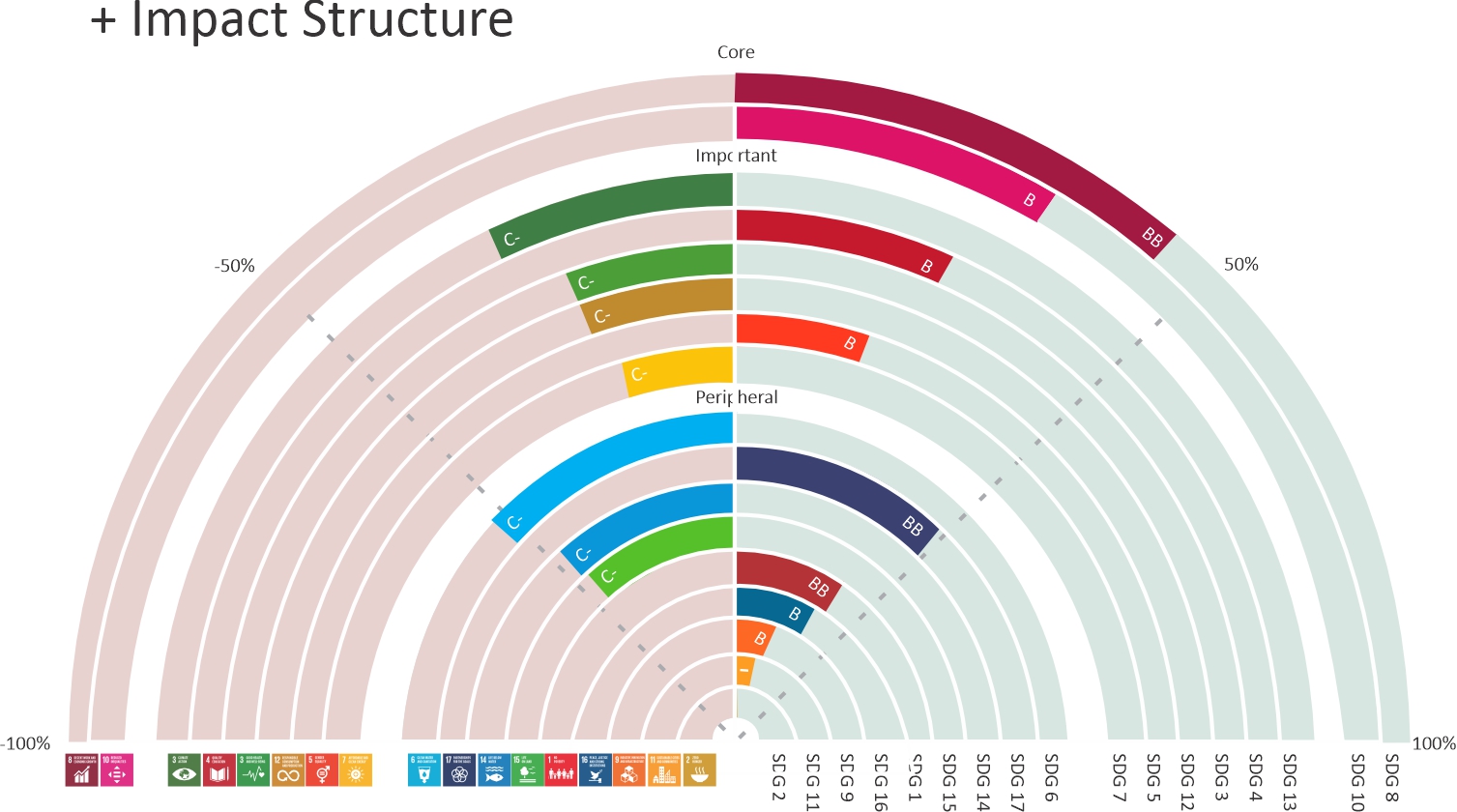
The impact rainbow is a powerful visual tool that showcases the net positive (on the right) and net negative (on the left) impacts of a portfolio. The most important SDGs are shown at the top (as core and important), with the less important ones shown as pheriperal at the bottom. This allows comparisons against selected benchmarks or other portfolios as well.
What next?
As a trustee, do you understand the impact of your fund’s investments?
Are you able to ask the right questions of consultants and asset managers, or are you merely receiving ESG input data?
ESG on its own has given us false comfort, ESG with impact gives meaning, depth, and the critical lens to assess whether we are closer to, or further from, creating a more sustainable world, a world worth retiring into.